

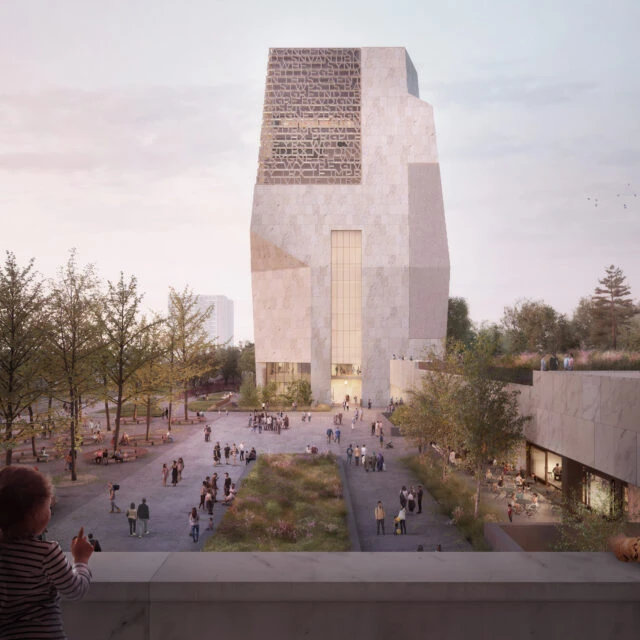
We sat down with The Obama Foundation to dig into the bold, values-driven vision behind the Obama Presidential Center, a campus designed not as a monument to the past, but as a launchpad for the future, rooted in Chicago’s South Side.
The Obama Foundation shares how the Center is challenging corporate and civic leaders to rethink their approach to investment, how its inclusive design is reshaping community ownership, and the concrete, measurable steps the foundation is taking to ensure the project delivers equitable economic impact in historically under-resourced communities.
EFG: What does the Obama Presidential Center represent for civic and corporate leaders, and how can it serve as a model for investing in historically under-resourced communities?
OF: The Obama Presidential Center embodies a deeply intentional approach to civic investment—one that begins with place, is rooted in people, and reflects the belief that real change happens when communities are not only heard but centered.
For Chicago’s civic and corporate leaders, the Center signifies a long-term investment in the South Side—a vital part of our city often overlooked in the distribution of resources. The Center is designed fundamentally as a community asset, with the vast majority of the campus free and open to the public. Our deliberate, values-driven choices—from investing in local workforce development to forming deep neighborhood partnerships—are foundational to how we believe lasting change should happen.
Nationally, the Center offers a replicable model: how to invest with communities, not just in them. It challenges leaders to rethink partnership and proximity, demonstrating that the most enduring solutions grow from the ground up, not from the top down. That is the essential vision and the example the Center sets for all committed to place-based changemaking.

EFG: How is the Center’s design, including public spaces like a museum, library, gardens, and athletic facilities, changing how institutions create space for community participation and shared ownership?
OF: From the very beginning, President Obama envisioned the Center as more than a tribute to his presidency. He wanted a place that belonged to everyone—from longtime South Side residents to visitors from around the world.
That vision has shaped a new kind of civic institution—one that is open, inclusive, and grounded in community.
The 19.3-acre campus is intentionally designed to be welcoming and accessible, with nearly every space and program offered free to the public. This isn’t a place people visit once; it’s a place for people to return to again and again.
- A new branch of the Chicago Public Library will provide a welcoming space for reading, learning, and community programming.
- Home Court at the Obama Presidential Center—a 45,000-square foot venue for sports, as well as wellness and youth career pathway programs, and more.
- The Forum—with an auditorium, media suite, and flexible meeting spaces—will serve as a hub for creative collaboration, dialogue, and global leadership development.
- An interactive Museum, spanning four floors of exhibits, will invite visitors to see themselves in the story of American democracy and discover their own potential to drive change.
These public spaces are connected by expansive public green spaces, enlivened by more than 25 commissioned artworks, and anchored by community-centered amenities like a playground, a fruit and vegetable garden, and locally inspired dining venues.
By bringing these elements together, the Center reimagines what a civic institution can be—not a distant monument, but a living, breathing space shaped by and for the community. It shows how thoughtful, inclusive design can create places where people not only participate but truly feel a sense of belonging and ownership

By bringing these elements together, the Center reimagines what a civic institution can be—not a distant monument, but a living, breathing space shaped by and for the community. It shows how thoughtful, inclusive design can create places where people not only participate but truly feel a sense of belonging and ownership.
EFG: What can CSR and nonprofit leaders learn from the Foundation’s approach to community engagement, particularly its efforts to include local voices in planning and development?
OF: The principle of “we” is central to everything we do, especially as we strengthen ties with the communities around the Obama Presidential Center. Last year, as we grew closer to opening the Center, we took the next step in our dialogue by hosting four community roundtables to ensure local residents play an active role in shaping The Center’s design, programming, and daily operations. In these sessions, 102 stakeholders from South Shore, Washington Park, and Woodlawn shared invaluable ideas, insights, and concerns to guide our decision-making as we prepare to open in 2026.
In recent months, our team has been out in neighborhoods across the city as part of our 77 Neighborhood Tour—showing up at local events, stopping by small businesses and coffee shops, and meeting people where they are.

At every stop, we connect with Chicagoans who are just beginning to imagine what the Center might mean for them. What’s most moving is how quickly curiosity can turn into ownership. Someone spots our logo and asks, “What are you all up to?” Minutes later, they’re flipping through renderings, lighting up as they envision themselves walking through its doors. They see the Obama Presidential Center. But more importantly, they see themselves as part of it.
That sense of connection only deepened this summer when we began inviting local residents to tour the perimeter of the construction site. It was an open invitation to walk alongside our senior staff and see the progress up close. Some were surprised by the access—but that’s exactly the point. This Center is being built for everyone, beginning with those who have long called these neighborhoods home.
EFG: How has the Obama Foundation built trust while addressing concerns about displacement, affordability, and equitable access to opportunity?
OF: From the very beginning, The Obama Foundation has been committed to a vision of shared prosperity—one where investment in Chicago’s South Side directly benefits the community that has long called this place home.
Building and maintaining trust requires more than words; it demands transparent, concrete action. That’s why we established Community Commitments—clear, measurable pledges focused on jobs, economic development, and housing stability.
In partnership with Lakeside Alliance and the We Can Build It initiative, we connected more than 10,000 local residents to construction training and career pathways. As a result, 50 percent of construction hours have been performed by Chicago residents, including 35 percent from the South and West Sides,

As the Center transitions from construction to operations, we are committed to sustaining this momentum by continuing to invest in and recruit talent from Chicago’s South Side.
Beyond workforce development, the Foundation is committed to using our convening power to bring residents, community leaders, and public officials together to address housing affordability and neighborhood stability. We’ve pledged to support policies that help long-time residents remain in their communities.
Building trust requires consistent engagement, active listening, and delivering on promises. We’re proud of the progress so far—and ready to continue advancing this work.
EFG: In what ways can the Center become a platform for partnerships that support education, civic engagement, and leadership development?
OF: The principle of “we” also applies to our work with our partners. One powerful example is The Obama Foundation Future Series, which exposes high school students to a variety of career pathways through intimate conversations with accomplished leaders about their experiences.
We believe that if you can see it, you can be it, and our corporate partners have played a critical role in making this happen.
During the 2024–2025 school year, students had the opportunity to tour O’Hare Airport behind the scenes, learning about career opportunities ranging from piloting to ground operations management. They engaged directly with Jason Mayden, Chief Design Officer at Nike’s Jordan Brand, in conversations about entrepreneurship, resilience, and dreaming big. They also met Calvin Butler, President and CEO of Exelon and one of just eight Black CEOs in Fortune 500 companies, who shared his inspiring journey to leadership.

This is just one example of how the Center serves as a platform for meaningful partnerships—ones that not only advance our mission but also support the business and social impact goals of our collaborators.
EFG: What can organizations learn from the Foundation’s approach to long-term funding and program sustainability?
OF: Organizations can learn that long-term impact requires long-term investment. The Obama Foundation’s approach to funding and program sustainability focuses on three key principles:
At The Obama Foundation, we understand that lasting change demands sustained commitment and investment in people. We see ourselves as part of a larger story that extends far beyond our moment, with the work we do today laying the foundation for generations to come. That is why we do more than provide funding: we design and run programs, convene leaders, and strengthen the networks and infrastructure that allow communities to thrive.
Our approach centers on place-based change. We do not claim to have all the answers; instead, we lift up local leaders to drive solutions in their own communities. Through investments in mentorship, training, and collaborative networks, we give these leaders the tools and connections they need to test ideas, expand impact, and sustain progress over time. In doing so, we help communities shape their own future, ensuring that meaningful change endures far beyond any single initiative.
EFG: As the Center opens, how is the Foundation planning for broader impact beyond Chicago, and what role can aligned organizations play in supporting its mission?
OF: From the beginning, President Obama has made clear: building the next generation of leaders doesn’t start with a building — it starts with a shared mission and sustained investment in people and communities. That’s why, even before the Obama Presidential Center opens its doors, our global leadership programs have already empowered more than 1,500 changemakers from over 160 nations and territories who are working to build more just and resilient communities worldwide—advancing solutions in climate action, racial equity, healthcare access, education, gender equality, and more.
Still, the opening of the Obama Presidential Center marks a critical turning point. It will provide these leaders with a permanent home — a place to convene, to collaborate, and to amplify their voices and visions. It will connect local action to global momentum. In short, the Center is not the conclusion—it’s the launchpad for what comes next.
So though rooted in Chicago’s South Side, the Center’s mission extends far beyond the city. It’s expected to welcome up to 1 million visitors annually, becoming a vibrant hub for changemakers from every corner of the globe.
This vision is only possible through partnership. Aligned organizations — across sectors and across borders — are essential to expanding our impact. Whether through philanthropic support, programmatic collaboration, or advancing shared values in their own communities and industries, our partners help bring this mission to life. Together, we’re building a global ecosystem of changemakers committed to shaping a better, more equitable future. Please reach out to cfr@obama.org to get involved.